
KILLING OF DAVE TUTT BY " WILD BILL HICKOK" (1865)
For some time after the close of the war Springfield was the resort of many hard characters Adventurers of every sort came in and met the ruffians of both armies, who lately disbanded , were seeking a livelihood by any means not involving hard work. Among those who were in the town in the summer of 1865 was one B. Hickok who came to be known as "Wild Bill," and as such has been made time hero of diverse improbable adventures set forth in certain flashy, sensational publications.
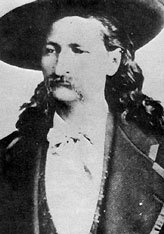 Hickok had been in the Federal service in Southwest Missouri and Northern Arkansas, as a scout, for the army of the frontier, and in the performance of his duties had grown to be well acquainted with danger, and being by nature a ruffian he soon became a desperado -- a drunken, swaggering fellow, who delighted when "on a spree" to frighten nervous men and timid women. After settling in Springfield a favorite diversion of his was to ride his horse on sidewalks and into saloons, hotels, stores, and other public places, and make the animal lie down and perform other tricks, to the infinite delight, no doubt, of the proprietors, none of whom, unfortunately, had grit enough to blow the bully's head off.
A man after Wild Bill's own heart was one David Tutt, an ex-Confederate soldier, who had lived at Yellville, Arkansas, and had come, with his mother, sister and younger brothers, to Springfield, early in the spring. Tutt was a ruffian and a crack pistol shot. He was said to have "gotten in his work," not only on Federal soldiers, but on citizens who had crossed his path against his protest. Both Tutt and Hickok were gamblers, and good ones, although the ex-Confederate was the more proficient of the two. The two men were boon companions for a time; the one touch of ruffianism made them both akin. They walked the streets together, they drank together, they gambled together -- and in the latter pastime Tutt effectually "cleaned out" Bill.
On the night of the 20th of July the two men played poker in a room at the "Lyon House," now the Southern Hotel, on South street. Hickok was the loser. First his money went; then his watch, a fine gold hunting-cased "Waltham," with a flashy chain and seal, then his diamond (?) pin and ring. He rose from the table completely strapped," and much irritated and crest-fallen. Everybody knew Wild Bill's watch, and after it had been surrendered to Tutt this night, Bill asked him at a special favor, not to wear it publicly, or let people know that it had changed owners, as he (Bill) felt bad enough already and did not want the evidence of his misfortune of his ill luck and bad playing, flaunted in everybody's face.
Tutt laughed a mocking laugh at Bill's humiliation and assured him that it would give him as much pleasure to wear the watch on the streets as it had already given him to win it. I intend wearing it in the morning,'' he added. Bill replied with an oath, "if you do, I'll shoot you, and I warn you not to come across the square with it on.'' The two men parted and retired to their rooms -- to put fresh caps on their revolvers!
The next morning Tutt put on his watch, -- and his revolver, too, and went down on the square. Going along the west side he entered the livery stable on the northwest corner and sat in the door where he could command a view of all four sides of the square, and especially of the Lyon House and South street. Very soon afterward Hickok came out of the hotel and down on the square, at the corner of South street. He stood on the west side of the street, and stopping one or two passers-by inquired if they had seen "Dave Tutt down town this morning?" On being told that Tutt was on the square, Bill said, "Well, it's all right if he hain't got my watch on, but if he has there'll be merry hell, you bet your life!" Tutt's younger brother came up, and to him Bill said, "You had better go and tell Dave to take off that watch;" and when young Tutt said he thought his brother had a right to wear what he pleased if it belonged to him, Bill answered, "He shan't wear that watch anyhow." Just then Tutt came out of the livery stable and walked south along the square. Bill saw him and exclaimed, "There he comes now." The little group about Bill scattered, and he took a few steps forward and drew his revolver, a Colt's dragoon, with cap and ball.
Just as Tutt reached the corner of the court-house and Campbell street, Bill called out, "Dave, don't you come across here with that watch." Tutt, as some say, drew his pistol, and almost instantly Bill fired, using one arm as a rest for his revolver. Tutt fell, shot nearly through the heart, and died very soon. Some deposed that Tutt's revolver was out of its scabbard when the body was first examined, and that Tutt had fired first. One chamber of the revolver was empty, and there were those who swore that they heard two pistol shots. Bill's shot was a fine one, but it is said by those who knew him well that it was a chance shot, for it is averred that when here Wild Bill was not considered a crack shot at all, and that his shot which killed Tutt at a distance of 75 yards was an accident.
As soon as he had fired and seen that his shot had taken effect Bill handed over his pistols to the sheriff, who came up, and informed that officer he was his prisoner. A few minutes afterward Bill was observed riding leisurely up South street taking the morning air. The circuit court was in session at the time. Bill was promptly indicted, arrested on a bench warrant, and brought to trial. He was vigorously prosecuted by the circuit attorney, Maj. R. W. Fyan, and ably defended by Hon. John S. Phelps. Witnesses testified that they heard two shots, and that the first came from near where Tutt's body was found. The empty chamber of Tutt's revolver was exhibited, and upon the ground of "reasonable doubt" that Hickok was the aggressor, the jury acquitted him. There were those, however, who asserted that Hickok was cleared because he was an ex-Federal and a Radical, and the man he shot was a "rebel," and the jury were all men who could take the "Drake oath." A prominent attorney harangued the crowd from the balcony of the court house, and denounced the verdict as against the evidence and all decency, and there were threats of lynching Bill, but nothing was done, and he was allowed to live until shot by another desperate character, named Jack McCall, at Deadwood, S.D.
(History of Greene County, Westerm Historical Company, 1883)
[BACK]
