
Strolling Through the Past
Springfield's past lives on around us. It takes only a little imagination and a little energy searching out its reminders to call it back.
There currently are over 50 locations throughout the community where Springfieldians can take a look at pieces of that history which remain preserved today or find markers calling attention to important events or places in the past.
Most visible are the actual historic sites that have been designated by the Springfield Historic Sites Board which started its work in 1970. By 1976 and the nation's Bicentennial celebration, this city board had identified, researched, and officially marked 15 old homes, educational buildings, churches and government facilities important to the city's past. That list has since grown to 46.
In addition to those actual structures or sites, there are several dozen markers throughout the area remembering events or locations from the city's history. Many of these were established through a project started by the University Club beginning in the early 1920s. That club's work was inspired by Dr. E.M. Shepard, a long-time member of the Drury College faculty and an early historian.
Many of these sites and markers, now that the weather is nice, can be seen on leisurely strolls through the various parts of town. The sites of historical significance are scattered throughout the community but a number are contained in two general areas of the central city which lend themselves to walking tours.
The downtown area surrounding Park Central is a wealth of historical reminiscences. As a start, toward historic sightseeing, we've developed a typical tour here.
Downtown Tour
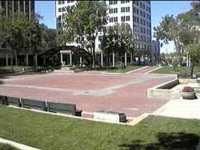 1. Start at a plaque on the southwest corner of Park Central which gives the history of the square. You'll be standing about where Wild Bill Hickok did when he shot Dave Tutt in that famous shootout in 1865. Dave Tutt was standing near what is was the Heer's store.
2. On the southeast corner of that store was a marker (now missing) telling about the old courthouse that stood on the site from 1861 to 1912.
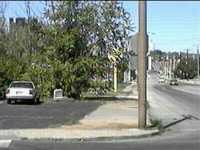 3. Walk west along College Street. Just west of the square in the south side of the street was located the K&K Chili Parlor reported to have served the finest hamburgers in the country. On the northwest corner of Main and College is a marker denoting the site of the first school in 1832.
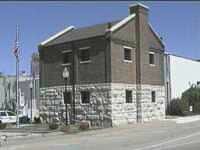 4. As you walk back east on the tuning fork, you easily spot the Old City Calaboose, one of the official historic sites. It was built in 1892. The plot has been significant in other ways as well. Early in the city's history, this was the city market lot where farmers sold their wares. From 1913 to 1933 it was the site of the Convention Center, at one time the largest in the southwest. Here, too, was located the city's first fire and police station.
5. Continue on east on McDaniel Street to South Avenue and then turn right. Behind the new facade of the Ozark Paper and Janitor Supply Co., is the old structure that was once the Mansfield Opera House, one of many theaters in early Springfield. Across the street was the Lyon House Hotel.
6. As you continue on south you'll see a marker on the south side of the present First Baptist Church telling about the original church which was located not far away, near the first school site.
 7. On the east side of South Avenue, just south of the church, stands the Day House, built in 1875 by George Day, former Mayor. It is one of the Springfield historic sites which is also included in the federal list of historic sites.
8. Walk through to Jefferson Avenue on what was once the extension of Mt. Vernon Street and you'll be at St. Agnes Cathedral, one of eleven churches on the list of Historic Sites. It was built in 1910.
 9., Walk north on Jefferson Avenue to Walnut Street and turn left for a visit to the Landers Theater, one of the best known of the local Historic Sites and also on the Federal Register. The location of many live stage shows since it was built in 1909 and among the first sound movies theaters in the country, it is today home of the Springfield Little Theater.
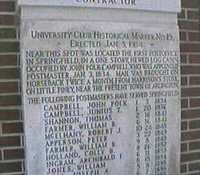 10. Head east again on Walnut Street. Just north of the intersection with Jefferson Avenue on the west side is a plaque noting the site of the first post office. Glance to the north toward the old Centerre Bank building and see the site of an important piece of Springfield history. This was the site of the Jewell Theater where the "Ozarks Jubilee" with Red Foley was telecast nationwide each week during the late 1950s.
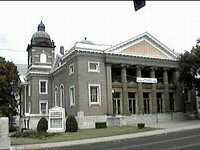 11. The St. Paul Methodist Church on the northeast corner is another historic site. It was opened in 1904.
 12. As you walk east on Walnut Street you'll see an unusual site. The huge Keet-McElhany house, typical of an era of opulence, is nestled in between commercial and government buildings. Built in 1881, and long the home of Mrs. Claude McElhany, is is now used for offices. It is an Historic Site.
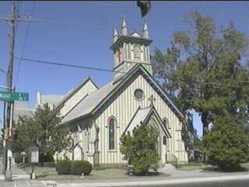 13. Another church, the oldest still in use in town, is Christ Episcopal on the northeast corner of Kimbrough Avenue and Walnut Street. The original wooden structure was built in 1870.
 14. Walking north from Walnut Street on Kimbrough Avenue, it'll be easy to spot the Shrine Mosque, another Historic Site. Built in 1923, it has since served as the entertainment and meeting center of the city.
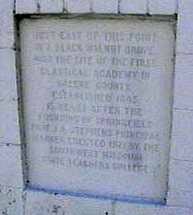 15. Turn left on St. Louis Street and go to the Travel Lodge Motel. In the west wall of the motel, along Short Benton Avenue, you'll find a marker denoting the site of the Stephens' Academy, the first classical academy in the city, started in 1845.
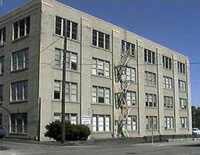 16. Go west on East Trafficway past the United Way building to Jefferson Avenue. Take a look at the Landmark Building on the northwest corner of Jefferson Avenue and Olive Street. Once the office for the Frisco Railroad here, it is one of the city's Historic Sites. This site also has another significance to the city's history. It was the site of the first store in the city in 1831 (denoted by a plaque in the south wall of the building). It was also the location of the city's first permanent public school building, the Old Central School, built in 1871.
 17. Continue on Expressway past Jefferson Avenue and then west on Water Street you'll get to the start of it all. A marker in the National Audio building on the north side of the street marks the site of the natural well where John Polk Campbell settled in 1829 to start the community. Founder's Park will soon be built on the south side of the street.
18. Go through to Boonville Avenue and then south toward the square again. The parking area on the northeast corner of Olive Street and Boonville Avenue is reported to have been the site of the first structure in the area, a cabin built by by A.J. Burnett before Campbell came but vacated when his claim was proven.
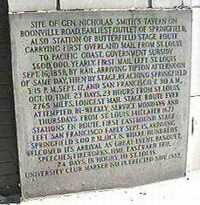 19. As you proceed back to the point on the square where you started, look for a marker in the east wall of the building on the northeast corner of the Square and Boonville Ave. This was the location of the hotel where the Butterfield Overland stage stopped. The stage was important to the development of the community when it came in 1858. The entire northeast section of the square you're passing was destroyed by fire in 1913, one of the city's most costly fires.
Depending upon how long you stop along the way on this tour as outlined it should take no more than an hour and a a half. If this entire tour is too much for one day, you can divide it into segments with those items to the west and south (through number 9) taken one time, the rest at another. On another day you might want to consider a similar walking tour of the governmental complex area a few blocks to the north of center city.
