
St. Petersburg
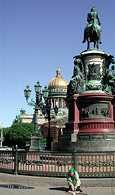
St. Petersburg - known at another time as Leningrad - is a more cosmopolitan city than Moscow. It has its own unique blends of architecture. St. Isaac's Square is located where the construction began for the foundation of the city. In the center is a statue of Emperor Nicholas I. Behind it is St. Isaac's Cathedral. It is named in honor of St. Isaac of Dalmatia whose feast day is on May 30, the ate when the birthday of Peter the Great, architect of the city, is observed.
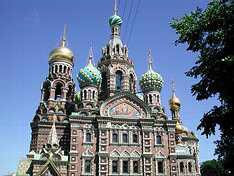
The most beautiful building in St. Petersburg, and most recognized, is the onion-domed Cathedral of the Resurrection. It is built on the site where 63-year-old Emperor Alexander II was mortally wounded by a terrorist. Because of this it also alternately known as "Our Savior-on-the-Spilt-Blood". The structure was started in 1893 but not consecrated until 1907. It is one beautiful piece of art.
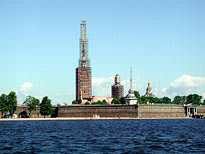
St. Petersburg is a city of rivers and canals. Because of this it is known as the "Venice of the North." From the River Neva one gets a good view of the Peter and Paul Fortress, built in the early 1700s by Peter the Great. Towering over the fortress is the 400 foot spire of the historic Cathedral of Peter and Paul. It is covered due to restoration work.
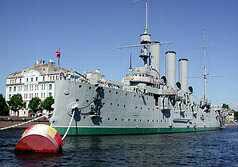
One of the sites tourists see while taking a tour of the waterways is this battleship Aurora which figured prominently in the Russian revolution when it fired a blank shot to signal the Bolshevik attack upon the Winter Palace.
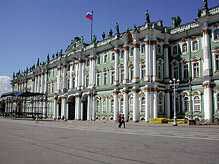
That Winter Palace was home of the country's royalty from Peter the Great to Nicholas II. It is more popularly known today as the Hermitage Museum, one of the finest art museums in the world. It features a collection that was started in 1760 by Catherine the Great and built upon by her successors.
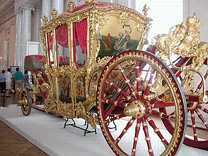
The Hermitage contains an amazing 2.7 million - from prehistoric items to collections of 20th Century art. It is said that if a person took only 10 seconds to look at each item in the collection it would take them three and a half years to see it all. In addition to precious art the Hermitage also includes items from the country's history such as this ornate coronation coach.
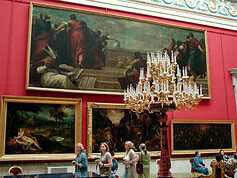
The museum contains the largest collection of French art outside of France. Included are works of art by these well-known artists: Michelangelo, Leonardo da Vinci, Velazquez, El Greco, Murillo, Goya, Rubens, Rembrandt, Cezanne, Matisse, Money, Degas, Gauguin, Renoir and Pissarro.
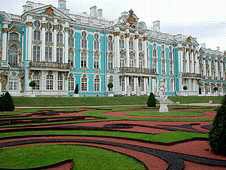
The Catherine Palace, named for Catherine I, second wife of Peter the Great, lies outside of St. Petersburg at Pushkin. The town is named for the famous Russian poet. .Like many of the historic buildings in the city it was currently undergoing massive renovation in preparation for the 300th birthday of St. Petersburg in 2003.
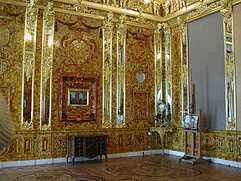
This palace is considered a Baroque masterpiece in white, gold, and royal blue. It as designed by Rastrelli who also designed the Winter Palace. A tour shows vividly how the royalty of the time lived with many fancy rooms, fine furniture, gold leaf trim and expensive artwork.
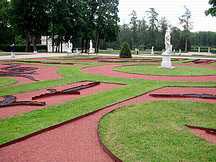
A highlight of a visit to the Catherine Palace are the formal gardens below the palace. One can spend a quiet time here visiting a variety of pavilions and monuments scattered throughout. A path through the gardens leads to the Great Pond and a nearby Pyramid, the burial spot of Catherine's favorite dogs.
It was only to about Pushkin that Nazi forces were able to advance at the start of World War II as they attempted to capture Leningrad. The determination of the Russian people to keep the city from the Germans resulted in a 900 day siege during which over 1 million people died, 800,000 from starvation. The story of the Siege of Leningrad is a remarkable tale of human stamina and resolve.

<<<Back to Map
